Agentic AI vs Generative AI: Key Differences and Use Cases
Vendors have quietly swapped their vocabulary. What was sold as an AI assistant two years ago is now sold as an agent, leaving buyers to work out whether anything actually changed. The confusion around agentic AI vs generative AI comes from a simple fact: these aren’t rival technologies competing for the same job.
Generative AI produces content in response to a prompt. Text, images, code, audio, a summary of a long document. You ask, it generates, you decide what to do with the output.
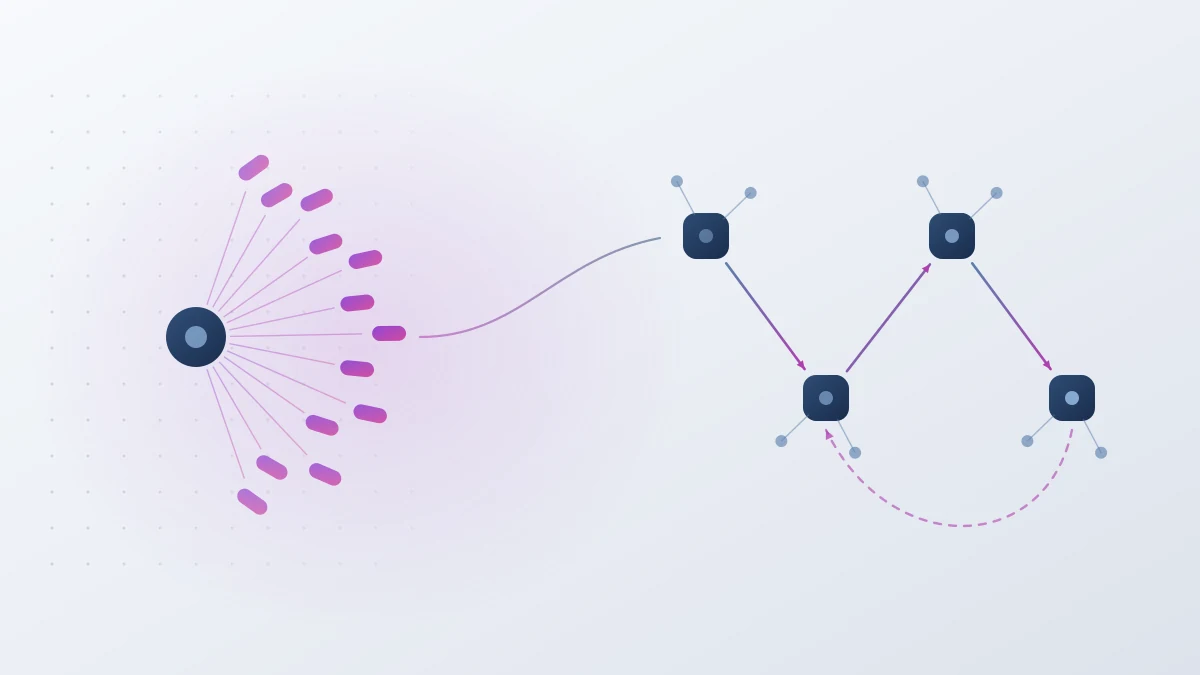
Agentic AI describes systems built to pursue a goal across multiple steps. They plan, call tools, read and write to other systems, and carry a task forward rather than stopping at a single response.
The relationship matters more than the contrast. Most agentic systems use a generative model as their reasoning engine; the agent layer surrounds that model with memory, tools and permissions so it can do something rather than describe what should be done.
What Is Generative AI?
Generative AI refers to models trained on very large volumes of data that produce new output rather than retrieve existing content. Large language models sit at the centre of the category, predicting what comes next in a sequence based on patterns learned during training. Beyond text, image models generate pictures from descriptions, speech models produce audio, code models complete functions.
What unites them is the interaction pattern. A request goes in, an output comes back, a human decides what happens next. ChatGPT, Claude and Gemini all work this way in their basic chat form.
The limitation is scope. A generative model asked to reconcile last month’s invoices will write an excellent description of how to reconcile invoices. It cannot open the accounting system and do it, because nothing has connected it to that system.
What Is Agentic AI?
Agentic AI covers systems designed to take a goal and work toward it through a sequence of steps, with some independence in choosing those steps.
Definitions vary across the industry. The label gets applied to everything from a scripted workflow with an LLM in the middle to systems that plan and re-plan dynamically, so treat “agentic” as a spectrum of autonomy rather than a fixed property.
Most systems described this way share several components:
- A goal rather than a single instruction: “resolve this ticket” instead of “write a reply.”
- Planning. Breaking that goal into steps and deciding what to do first.
- Tool use. Calling APIs, querying databases, running code, updating records.
- Memory. Retaining what happened earlier so later steps build on it.
- Multi-step execution with checks along the way, including asking a human when something falls outside its remit.
A practical example
Say a customer emails about a duplicate charge. A generative AI tool drafts a reply; someone then reads it, checks the billing system, issues a refund, updates the CRM and sends the email.
An agentic system built for this workflow might look up the account, confirm the duplicate charge against transaction records, apply the refund if it falls inside a pre-approved limit, log the action, draft the reply and queue it for review.
Note the conditions there. The refund limit, the approval step, the logging: all designed in. Agents work inside boundaries their builders define, and those boundaries do most of the work in making them safe to deploy.
Agentic AI vs Generative AI: Key Differences
| Factor | Generative AI | Agentic AI |
|---|---|---|
| Primary purpose | Produce content or answers | Pursue a goal through multiple steps |
| Main output | Text, code, images, audio, summaries | Completed actions and workflow progress |
| Autonomy | None beyond the single response | Varies by design, always bounded |
| Planning | Reasons within one output | Sequences steps and adapts as it goes |
| Tool use | Limited or none in basic form | Central — APIs, databases, business software |
| Human involvement | Human triggers and reviews every output | Human sets goals, approves sensitive actions, monitors |
| Typical use cases | Drafting, summarising, coding help, research | Support resolution, IT operations, data workflows |
| Example | Asking a model to draft a project brief | A system that drafts it, files it and notifies the team |
The plainest way to hold the distinction: generative AI answers the question what should this say? Agentic AI answers what should happen next, and who does it?
How Agentic AI and Generative AI Work Together
They’re layers of the same stack more often than they’re alternatives.
Inside an agent, the generative model handles the language and judgement work: interpreting a vague instruction, choosing which tool fits the current step, reading an unstructured PDF, writing the customer-facing text at the end.
The agent framework wraps that model in the machinery it needs to act — connections to APIs and databases, access to CRM or ticketing systems, search over internal knowledge bases, a record of what’s already been done, and rules about which actions require approval.
Architectures differ. Some run a single model in a loop; others coordinate several specialised components. There’s no standard blueprint, so calling a product “agentic” tells you little until you know what it can reach and change.
Generative AI Use Cases
The strongest business applications are the ones where a human reviews the output before it matters.
Content and marketing. First drafts of posts, product descriptions, ad variants and email sequences, with editors verifying the result.
Summarisation. Condensing meeting transcripts, long threads or contract sections into something readable in a minute.
Coding assistance. Autocompleting functions, explaining unfamiliar code, writing tests.
Drafting and research. Proposals and internal memos from a structured brief, plus background on a company, market or technical question.
Agentic AI Use Cases
These involve doing rather than producing, so what the system can touch matters as much as what it decides.
Customer support. Reading the ticket, checking account records, performing a bounded action such as a refund, updating the case and drafting the response.
IT operations. Triaging alerts, checking logs across services, correlating them into a probable cause, then applying a known fix or escalating with the evidence attached.
Software development. Coding agents that take an issue description, locate the relevant files, change the code, run the tests and open a pull request for review.
Sales operations. Enriching new leads, scoring them against defined criteria, updating the CRM and scheduling follow-ups.
Data and internal process workflows. Scheduled analysis that flags anomalies for a human; onboarding, procurement and compliance routines that span several systems.
Advantages and Limitations
Generative AI
Speed and access are the advantages: a first draft in seconds, useful output without specialist training, real gains on the writing and research work that fills knowledge-worker calendars.
The limitations are well documented. Models produce confident, fluent output that is sometimes wrong, and they work only from what’s in the prompt. Review stays necessary for anything consequential.
Agentic AI
The advantage comes from removing handoffs. When a system completes a workflow instead of contributing one step, the coordination cost disappears with the manual work.
The risks scale with that capability. An error in step two propagates through steps three to nine, and an agent with write access can do real damage before anyone notices. Permissions need tight scoping, actions need audit logs, consequential decisions need approval gates, and reliability across long task chains remains an active engineering problem. Agentic systems change what oversight looks like — reviewing what a system did rather than approving each step — but they don’t remove the need for it
Which Is Better for Your Business?
The honest answer depends on whether your problem is a content problem or a process problem.
Generative AI fits when the bottleneck is producing something: drafting, summarising, brainstorming, generating code or media. The output goes to a human who decides what to do with it.
Agentic AI fits when the bottleneck is a repetitive multi-step process spanning several systems, where decision rules can be defined clearly and actions can be bounded and audited.
Agentic systems also need integrations, permissions and monitoring, so implementation costs sit well above buying seats for a chat tool. They depend on clean data in the systems they act on, which is why these projects often stall on data quality rather than AI capability.
Most organisations end up running both: generative tools across teams for daily work, agentic systems built deliberately for high-volume workflows where the return justifies the engineering.
Final Verdict
Generative AI creates. Agentic AI acts.
That distinction changes what you ask a vendor. For a generative tool: output quality and review workflow. For an agentic system: what it can access, what it can change without asking, and how you find out when it gets something wrong.
The agentic AI vs generative AI framing suggests a choice, but in practice one sits inside the other. The generative model supplies the reasoning; the agent layer supplies the reach. What separates a useful deployment from a risky one is rarely the model — it’s how carefully the boundaries around it were drawn.
Frequently Asked Questions
What is the difference between agentic AI and generative AI?
Generative AI produces content in response to a prompt: text, code, images or summaries. Agentic AI pursues a goal across several steps, planning its approach, using tools and taking actions in other systems. One creates output for a human to use; the other carries a task toward completion.
Is agentic AI a type of generative AI?
Not exactly. Generative AI is a category of model; agentic AI is a way of designing systems. Most agents use a generative model as their reasoning component, so the two overlap heavily in practice, but an agent is defined by its ability to plan and act rather than by what it generates.
Can generative AI become agentic AI?
A model on its own doesn’t become agentic. It becomes part of an agentic system when developers connect it to tools, give it memory, define its permissions and let it run several steps toward a goal. The intelligence comes from the model; the agency comes from the architecture around it.
How does agentic AI use generative AI?
The generative model handles language and judgement: interpreting instructions, deciding which tool to use next, reading unstructured documents and writing the final output. The surrounding framework supplies connections to APIs, databases and business software, plus the rules governing which actions need human approval.
Which is better for business, agentic AI or generative AI?
Neither is better in general. Generative AI suits content, drafting and research, and deploys quickly. Agentic AI suits repetitive multi-step processes across systems, but requires integration work, permission design and monitoring. Companies typically adopt generative tools broadly and build agentic systems selectively where volume justifies it.
